Security services across code, connectivity and architecture
We help organisations identify and reduce security risks across software, connected systems and the wider security architecture.
Every engagement starts by understanding the system, its exposure and the questions that need answering. From there, the assessment can move from implementation-level code review to network connectivity, architecture, threat scenarios and organisation-wide security improvement.
How the model works
A layered security assessment model
Security weaknesses rarely exist at only one level. A flaw in code may become critical because of network exposure, excessive trust or weak architectural controls. Conversely, strong architecture can limit the impact of an implementation weakness.
Proofline therefore works through a layered model, beginning with context and baseline assessment before moving deeper where necessary.
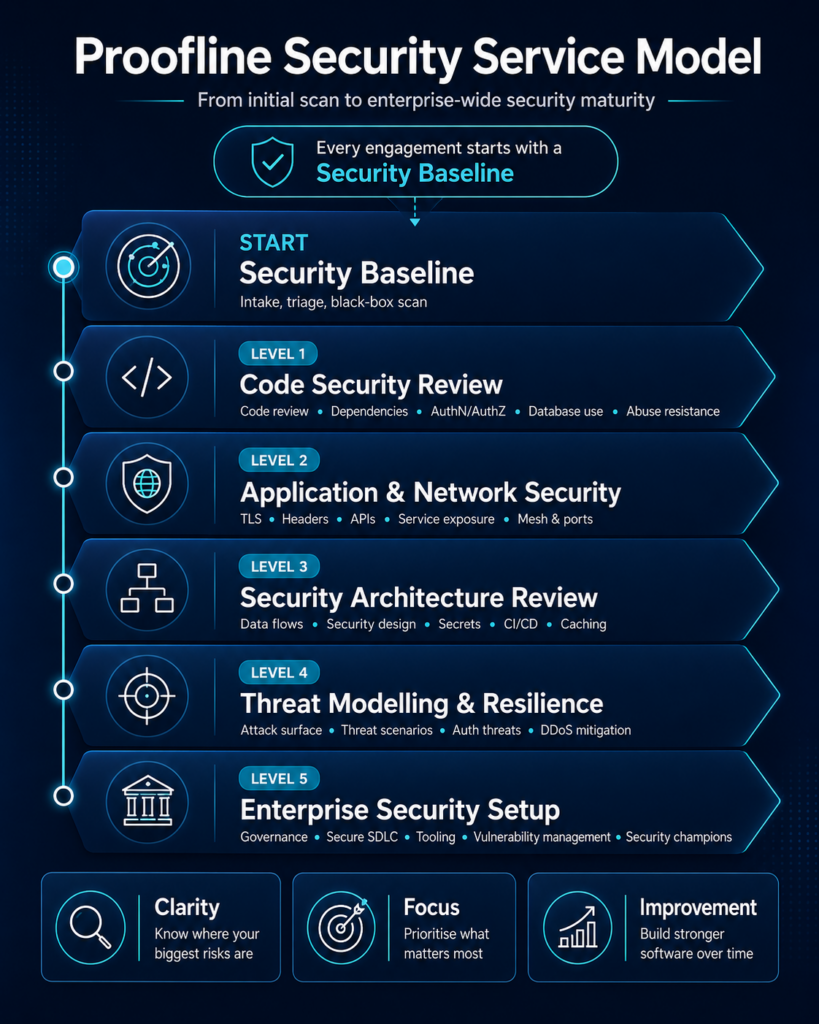
Engagements do not need to cover every level. The model helps determine where additional depth provides the most value.
Every engagement starts with context
Intake & Security Triage
We establish the business context, critical assets, main concerns and practical constraints.
Security Baseline
We examine externally visible exposure, reachable services and initial security signals to determine where deeper assessment is justified.
Service areas
Application Security Services
Security assessment at the application and connectivity level.
- Code Security Review
- Application & Network Security
- API and service exposure
- Authentication, sessions and transport security
Architecture Security Review
Assessment of the wider system design and security controls.
- Trust boundaries
- Identity and access
- Network topology
- Monitoring, detection
- Resilience and recovery
Threat Modelling & Resilience
Assessment of realistic threats, attack paths and the system’s ability to limit and recover from compromise.
- threat scenarios and abuse cases
- attack paths and privilege escalation
- lateral movement and blast radius
- detection and containment
- resilience and recovery
Enterprise Security
Support for making security structured, repeatable and sustainable across teams and systems.
- secure development practices
- security standards and governance
- roles and responsibilities
- technical assurance processes
- metrics and continuous improvement
What to expect
Each engagement is tailored to the system, risk context and questions that need to be answered.
- Scope and objectives
We define the system, assessment depth, relevant concerns and practical constraints. - Technical assessment
We examine the agreed areas using manual analysis, appropriate tooling and supporting validation. - Prioritisation and reporting
Findings are assessed in context and translated into clear technical and business priorities. - Technical walkthrough
We discuss the findings, implications and recommended next steps with the relevant teams. - Remediation and retesting
Where agreed, we support clarification during remediation and reassess implemented improvements.