Security assessment from source code to application connectivity
Proofline Security helps organisations identify security weaknesses within applications and in the way those applications interact with users, services, data stores and networks.
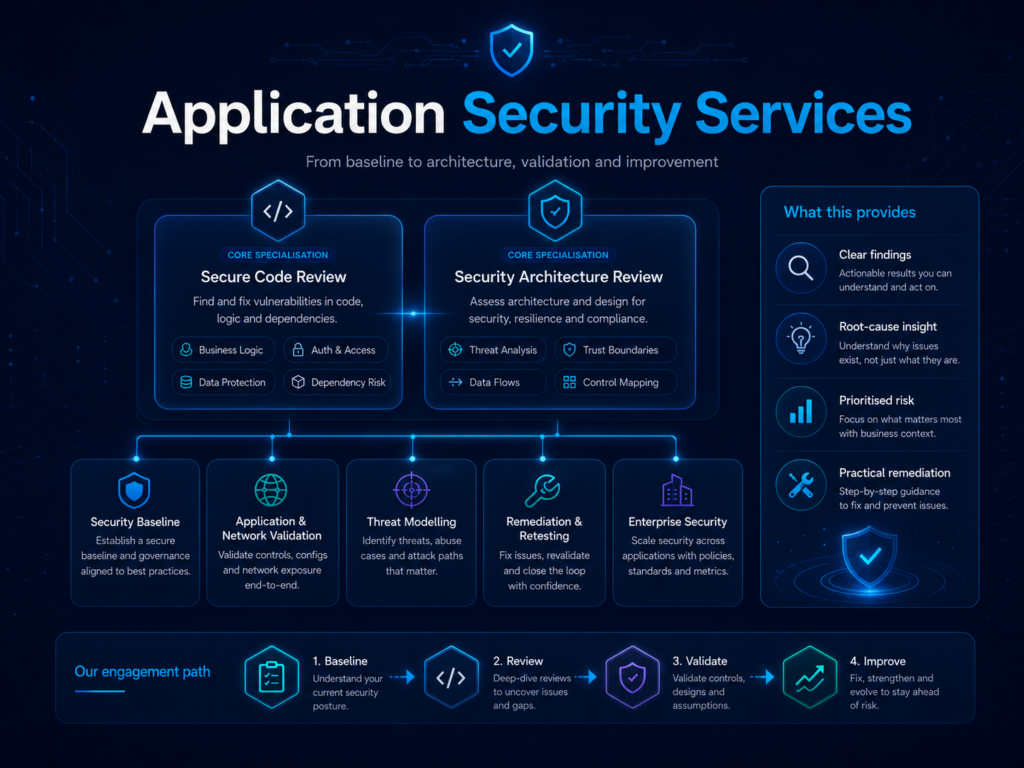
Our application security services cover two connected levels of assessment. At the implementation level, we examine source code, business logic and security-critical development choices. At the connectivity level, we assess the application as a system component, including its exposed interfaces, authentication flows, network connections and communication with other services.
Our reviews combine manual analysis with appropriate automated tooling and supporting validation. Rather than relying on scan results or generic checklists, we examine findings in the context of the application, its role within the wider environment and the risks that matter to the organisation.
The result is a clear, prioritised assessment with practical guidance for developers and technical teams.
Code Security Review
We examine the application from the inside, focusing on source code, implementation choices and application logic.
Typical areas include:
- authentication and authorisation
- business logic and abuse cases
- input validation and data handling
- cryptography and secrets
- dependencies and supply-chain risks
- error handling and application resilience
Application & Network Security
We assess the application as a connected component within the wider technical environment.
Typical areas include:
- APIs and exposed interfaces
- session and identity flows
- transport security
- ports, protocols and service exposure
- connections to databases and internal services
- network zones and reachable systems
- configuration and deployment-related risks
When to consider an application security assessment
An assessment can be particularly valuable:
- before a major release or production launch;
- after substantial changes to authentication, authorisation or data handling;
- when an application has grown significantly in complexity;
- before integration with new customers, partners or external services;
- when automated testing provides insufficient assurance;
- following the discovery of a serious vulnerability;
- when preparing for customer, regulatory or internal security scrutiny.
The scope can range from a focused review of a specific risk area to a broader assessment of the application and its connectivity.
What you receive
Each assessment is tailored to the agreed scope, but typically results in a clear and actionable set of deliverables for both decision-makers and technical teams.
Prioritised findings
A structured overview of identified weaknesses, including their severity, technical context and potential impact.
Supporting evidence
Relevant technical evidence showing where the weakness occurs and why it represents a security risk.
Practical remediation guidance
Clear recommendations that help development, platform and operations teams address the underlying issue rather than only its visible symptoms.
Management summary
A concise overview of the most important risks, recurring patterns and recommended priorities for stakeholders who do not require the full technical detail.
Technical walkthrough
A review session in which the findings, implications and recommended next steps are discussed with the relevant teams.
Retesting
Where agreed, implemented improvements can be reassessed to confirm that the original weakness has been addressed effectively and has not introduced new risks.
Security in context
Code weaknesses and connectivity risks often reinforce one another. A small implementation flaw can become critical when an application is broadly exposed or has excessive access to other systems.
Where broader design questions arise, findings can lead into a separate Architecture Security Review, focused on trust boundaries, segmentation, control placement, monitoring and resilience.